"We are blessed by the generosity of Ron Moore's family, and this partnership is a living tribute to his memory," Peg Bradley-Doppes, then DU's vice chancellor for athletics, said in August 2011, in a University of Denver Athletics announcement that named Highlands Ranch Golf Club the official home of the Pioneers' men's and women's golf teams. The next year, the Moore family gave the course itself to the university.
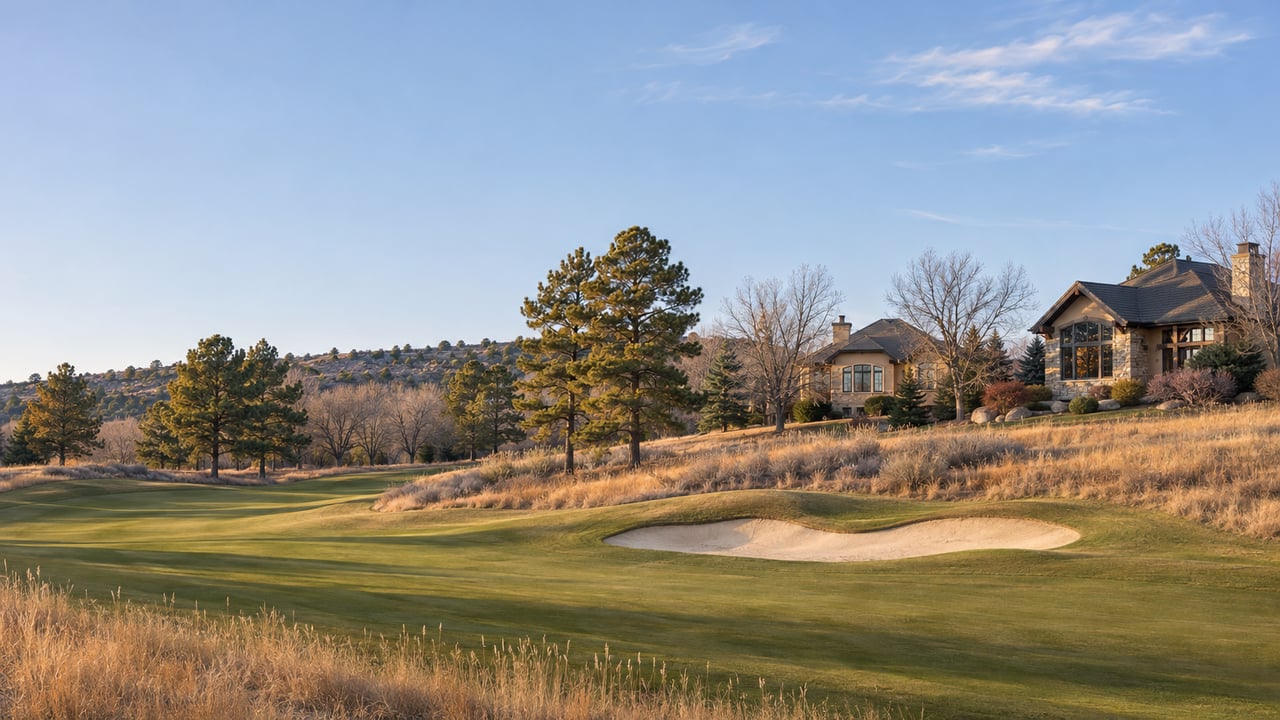
For anyone buying a home along that course, this history decides what the purchase includes. The fairway behind the house belongs to a university that runs it as a semi-private club, and the club's own membership page lists memberships as sold out, with a waitlist. In Highlands Ranch, a golf-course home buys the setting. Getting onto the course as a member is a separate decision, made with the club and on the club's timeline, and it is best settled before a course-side home comes up for sale.
A homestead, a trustee and a university
The land under the course has a longer history than Highlands Ranch. The Highlands Ranch Community Association says Rufus "Dad" Clark filed a 160-acre homestead in 1859 on the ground where Highlands Ranch Golf Club now stands. In 1871 he auctioned potatoes to raise relief money for victims of the Chicago fire. According to HRCA's community timeline, construction on the community's second golf course began on that land in 1997.
Ron Moore came to the University of Denver on a golf scholarship in 1951 and played for the Pioneers through 1954. He was inducted into the Colorado Golf Hall of Fame in 1987 and was general chairman of the 1985 PGA Championship at Cherry Hills Country Club. From 1986 until his death in 2003 he served on DU's Board of Trustees, where he chaired the investment committee. Today the course is the University of Denver Golf Club at Highlands Ranch, an 18-hole, semi-private course designed by Hale Irwin. It plays to par 72, and its restaurant is The Grill. The address is 9000 Creekside Way, Highlands Ranch, 80129.
Semi-private means the course runs two booking systems. The club's website links to public tee times and member tee times separately. A homeowner along the fairway who is not a member books through the public system like any other golfer in the metro.
The membership sits apart from the address
The club sells two annual memberships, priced by how many days a week a member plays. The membership page lists the 7-Star membership, with unlimited golf seven days a week, at $5,400 a year for an individual. The 4-Star membership covers unlimited golf Monday through Thursday for $4,100. DU alumni pay $4,860 and $3,690 for the same two tiers. No initiation fee appears on the page. Members get tee-time reservations 14 days out, discounted guest and cart fees, club charging privileges, member tournaments and social events, and, for an extra fee, club storage and a private range program. A corporate option sells a book of round certificates, such as a 30-round pass for $3,360.
At those prices the dues are not what decides the purchase. For a household looking at homes in the luxury range, $5,400 a year is small next to the mortgage. Availability is what decides it. The club takes waitlist requests by email or by phone at 303-471-0000. A buyer who expects to play several days a week should know where they stand on that list before writing an offer on a course-side home.
Association costs beside the club dues
The neighborhood around the course has its own association. HRCA lists the HOA at Highlands Ranch Golf Club among its sub-associations, managed by Associa Colorado.
HRCA's assessment page puts the 2026 assessment at $696 a year. On October 20, 2026, the association approved $715.60 a year for 2027. For a golfer budgeting a course-side home, club dues are one more line beside those association costs, and the sub-association's own amount is worth requesting early along with everything else. Our earlier piece on how Highlands Ranch's flat HRCA fee hides cost differences one layer down covers that second layer across the community, and our metro district guide for Highlands Ranch buyers covers the property tax side.
These figures are general information as published by each organization, not legal, tax or financial advice. Confirm current amounts for a specific address with the association and the right professional before you commit.
The Links works on a different arrangement
Highlands Ranch has a second course, one that fits a different kind of golfer. The Links Golf Course is an executive layout, par 62, with 9-hole and 18-hole rounds. Its rate card lists separate green fees for Highlands Ranch residents and nonresidents, so any golfer can play it without a membership. As of mid-November, the course's website said carts would stay on the paths and the range would use artificial mats for the rest of the season.
The homes around The Links are in Gleneagles Village, which wraps around the east side of the course at 5815 E Gleneagles Village Pkwy. HRCA lists Gleneagles Village as a 55-plus community with its own homeowners association. For a golfer who wants a quick nine close to home, the shorter course with resident pricing at the counter may fit better than a full-length Hale Irwin layout with a membership waitlist.
Lone Tree as the nearby option for a membership
For a golfer who wants membership-level access while the DU waitlist moves, the closest full-length option in the research is just outside the community. South Suburban Parks and Recreation runs Lone Tree Golf Club & Hotel at 9808 Sunningdale Blvd in Lone Tree, an 18-hole course designed by Arnold Palmer. Its published annual individual memberships are $3,400 for district residents and $4,600 for nonresidents. A household can live on the DU course for the view and play at Lone Tree as members, and some golf buyers do better with that combination than with waiting.
October's luxury numbers favor buyers who decide early
The case for settling the membership question first gets stronger with the latest market data. The Denver Metro Association of Realtors' October 2026 market trends report, released November 4, puts the metro-wide median detached price at $645,000 for October, with a median of 26 days on market.
The $1 million-plus segment moved faster than that. Across the Denver metro, homes at that level closed 4,878 sales from January through October 2026, against 4,890 in the same stretch of 2025, for $8.0 billion in volume. The year-to-date median was 16 days on market, and sellers received 98.27% of list price. October alone had 24.05% fewer $1 million-plus closings than October 2025. The median time on market dropped to 17 days, from 34 a year earlier.
So in October there were fewer luxury sales than a year earlier, and the ones that happened went in half the time. For a buyer waiting on one specific kind of home, a lot backing onto a particular fairway, that combination is what matters. In a slower winter, fewer course-side homes come to market, and when one does, the October pace leaves about two and a half weeks to act. That is not enough time to also call the club, learn where you stand on the waitlist, price a Lone Tree membership and decide whether the house still makes sense without golf access. Buyers who have already worked through those questions can move within the 17 days. Our guide to timing a Highlands Ranch sale covers the same calendar from the seller's side.
If a home along the University of Denver Golf Club at Highlands Ranch or around The Links is on your list for 2027, Luxe Haven can help you sort out the club, the associations and the timing first, so you can act as soon as the right lot is listed. Request a Private Consultation with Ashley Behrens.